Monday, July 13, 2015

Driving the Dingle Peninsula


The rain kept us from exploring the Dingle Peninsula as much as we would have liked. We drove up the east coast, planning to enter Dingle from Connor Pass, which is quite scenic in sunshine.  But when we reached the top of the pass, it was fogged in, right at the waterfall.

Because the roads of Ireland are often congested like this…


And because the road narrowed to one lane with only pullouts (lay-bys) for vehicles to pass with a sign showing how steep the grade was…


We decided to turn around and come into Dingle by another route. When the fog lifts the landscape of Dingle is beautiful, as these photos show:


Eventually, we arrived at our destination, where we spent the night in a cottage with a turf roof.  It was delightful!  We had the most welcoming hosts, Louise and her husband Chris, who were extraordinarily helpful with our plans for Ireland and for our later visit to England’s Peak District, where they live most of the time. Our cottage, “The Nest,” was next to their holiday home. It was so charming, we were sorry we were only staying one night.


Thursday, July 9, 2015

Trad Music and Towering Cliffs


We went to Doolin because it is the capital of traditional (trad) music in Ireland. However, I think almost every pub in Ireland has traditional music, so perhaps we didn't need to go that far.

Doolin is also close to the Burren, the barren area of landscape in County Clare that is composed of karst. It extends about 250 kilometers. There are also ancient dolmens and standing stones throughout the area.  It is said to be very beautiful in the spring when flowers bloom amid the rock, some of which are unique to the area, including a rare orchid. But it does look desolate at times.


The music doesn't get started in the pubs of Doolin until late--about 9:30--which is our usual bedtime. The first night we were there we felt bad, because our host at our Airbnb lodging is a musician and was performing that evening, but after our dinner and a pint at the pub, we were exhausted and missed her event.  We went back and slept for more than 10 hours. We never do that!

The next night we were a little smarter.  We took a nap, so we could stay up to hear the music.  Each pub in Doolin specializes in a different type of music. The pub we were in featured pipes. We heard an expert playing the uilleann pipes. Unlike the Scottish highland bagpipes, the uilleann pipes are not as loud, are played sitting, not standing, and they reach two full octaves. They are said to be very difficult to play. The pub was so packed, I couldn't get a photo, but it was a delightful evening with tourists and locals crowded round.


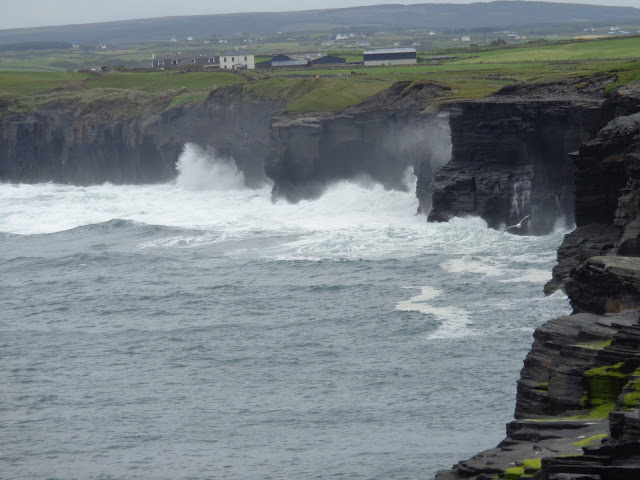
A path to the Cliffs of Moher begins in Doolin, and we couldn't wait to try it. We met a German couple who were walking the cliffs, and I offered to take some photos of them. (Because I didn't ask them if I could post their photos online, I'm only showing them from the back.) They were actually closer to the edge than the photo shows.


Our family will find it hard to believe that I, with a fear of heights, made this walk, but I did. I had a thin strand of wire rope (from the cattle fence) to grasp at the scariest place.  We were very happy we had taken the walk and had seen the cliffs with only a few people, because later when we drove the car to the official site, it was swarming with people. The cliffs were still beautiful, but not nearly as exciting.


Monday, July 6, 2015

A Brief Stay in Connemara

Sheep near shed in countryside

We had a choice of staying a night in Galway or in Connemara, and although Galway is said to be a pretty city, we usually prefer the countryside, so we decided to drive to Connemara instead.

We had a long day of driving to get there, and we arrived at our B&B on the coast in a blinding rainstorm. We got soaked just getting from our car to our B&B, where the owner opened the door and welcomed us in to her home, warmed by a peat fire. (I'm sorry I got no photos of the B&B, nor of the nearby restaurant where we had our best meal out of our trip so far--mussels for me and seafood chowder and salad for Kevin. The Western Irish coast is known for its good seafood as well as for its stunning beauty.

Because of the rain, many of my photos seemed washed out. But here are some of the better ones: 

Lake near Kylemore Abbey.

View of lake and Kylemore Abbey.

Kylemore Abbey, which was not an abbey, but a home a wealthy man built for his wife.

A farm in the heart of Connemara.

View from our drive through Connemara.

A Connemara pony? They are large--usually about 14 or 15 hands.


Saturday, July 4, 2015

Kevin's Posh Rest Stop

Glenlo Abbey Hotel is adjacent to the church

Desperate times call for desperate measures. On our way to Connemara, just outside of Galway, Kevin needed to answer the call of nature.  But we could find no filling stations (they still call them that here), nor even a pub on our route.  He was getting antsy.

Finally, he pulled into a beautiful tree-lined drive that led to the Glenlo Abbey Hotel and Country Club, an old stone structure which is situated on a very attractive golf course.  He steered the car around to the back of the hotel, which was right next to an old church.  Over the back door was a sign that said, “Golfers and non-residents welcome.” 

“Well,” Kevin said, “that’s for me.”

I waited in the car as he entered, and eventually he came out.  “It was perfect,” he said. “A very nice restroom and a nice bar, but I didn’t even have to buy anything, because the toilet was just down the hall.” (If you’ve been to Ireland or England, you know that they don’t use the term “restroom,” or “bathroom,” but instead use the direct term “toilet.” If you ask for a “restroom,” you could get a strange look.)

So we continued on our way.

Later, returning from Connemara, we found ourselves at the same spot in the road.  This time, both of us were sensing the call of nature.  So, once again, we pulled into the Glenlo Abbey Hotel and Country Club.
As we were getting out of car, a young woman, carrying an apron, greeted us with a “hello.” We responded, assuming she probably worked there, as she entered the staff entrance nearby.  We went into the bar entrance, and, as Kevin had before, we walked down the hall without entering the bar.  (We would probably have gone in and bought coffee, had we not been in a hurry, as a courtesy for using the toilet.)

While I was in the stall, I heard another person in the ladies room.  Because we had kind of sneaked in, I waited for her to leave, but she didn’t, so eventually I decided the heck with it, and came out to use the sink.  The young woman whom we had greeted on our way in was at the mirror fixing her hair.  She struck up a conversation about the weather, and I chatted with her for a moment before exiting.

Spotting Kevin emerging from the “gents” toilet, I whispered, we need to get out of here, and we set a brisk pace down the hall and out to the car. “What’s the matter,” he asked as we left the building. I explained that the woman staff member had seen me in the toilet and if she went into the bar, she might suspect we had sneaked in.

Now honestly, what would she or the manager have done anyway?  They would hardly throw us in jail for using the toilet without paying for anything!  But it was such a nice place that I felt a little awkward. If we’re ever in the area again, we must go to the bar of the Glenlo Abbey Hotel and Country Club and buy a drink. We owe them!


A Walk with History


Pathway along the River Boyne

Earlier in the day that we went to Monasterboice and Mellifont, we had a long walk along the River Boyne to the site of the Battle of the Boyne. That pivotal 1690 battle, won by William of Orange, resulted in Ireland being kept under British Protestant domination, with reverberations to the present day. We went there not because of the battle, but because it was at the end of a beautiful river walk. Altogether, we calculated we walked 10 miles that day.

We encountered a few people on the path, including a woman walking her dog (Lucy?), who stopped and chatted with us for several minutes. She talked about the state of the world. “But I have hope in the young people,” she said.  Because we are from the U.S., she mentioned the Irish in America and the potato famine (1845-49) that drove so many to our shores. I realized, of course, that the famine had seared the Irish soul, because so many millions of people died of starvation or were forced to leave their homes. But I don’t think I realized until speaking with her how close to the surface that era still is. Her whole voice and body language changed as she spoke passionately of that time.  For us, it was no longer just a river walk. It was a walk with history.


Photos of Oldbridge House, a museum at the Battle of the Boyne site and the walled garden there


Of Tombs and Treasure Hunts

Countryside near Fourknocks Tomb

When we took the walking tour of Drogheda, our guide asked Kevin if he had been to Newgrange. “Oh, yes,” Kevin said.  “We really enjoyed it.”

“How would you like to go to a tomb you can visit all by yourself?,” the guide asked, with a hint of a smile.

That was how we found out about Fourknocks, a small megalithic tomb of about the same age as Newgrange and the procedure for visiting it. Although it is mentioned on a couple of websites, it’s not one that most tourists ever hear about.  Of course, we had to go!

Because we didn’t have a car while we were in Drogheda, we investigated every way we could think of to get to Fourknocks, which is in a farmer’s field about 11 kilometers from Newgrange. But there were no buses that traveled that area, and the only recourse would have been to hire a taxi, which was too expensive. So although we had a long drive ahead of us on the day we picked up our car at Dublin Airport, we decided we would find Fourknocks first.

We had a number for Mr. Finian Whyte who takes care of the key for the site. I called and talked to Mrs. Whyte who said she would be home all day Saturday, and we could come and get the key. But finding the Whyte place wasn’t easy.

Kevin input the coordinates of Fourknocks (so called because the Irish name for the site sounds like that in English), but following our GPS, we found ourselves far from the actual place. As we considered going back to a nearby village, the starting point of the directions that I had found online, a man and woman pulled up in a car, and seeing we seemed confused, asked what we were looking for.  When we replied, “Fourknocks,” the woman smiled and said, “Oh, you’re going completely in the wrong direction!” (Of course, we already knew that.) But with her directions, we made it to another nearby town and Kevin asked a gentleman sitting in a parked car there, who, as Kevin said, “Told me every landmark from here to there.”

We did find the path to Fourknocks with his directions, but the sign at the site, which told us how to find the Whytes, was only marginally helpful.  We made another other wrong turn before we turned up at the right door. At last our treasure hunt was over. We range the bell, and Mrs. Whyte, a thin woman with a lined face and graying hair, accepted our 20 euro deposit, and the key was ours. (We later gave her something for her trouble, which seemed only fair.)

We drove back to the path to the tomb and parked, a little nervous because another car was parked there. Mrs. Whyte said she had given another key to someone just before us, so we thought that might be the couple in the car, but they didn’t get out, so we hoped they were not there to steal from us. But it was only a momentary thought.

We soon forgot about them, walked in to the tomb, unlocked the door and went in.  The rock carvings in the tomb are very well preserved. I did not want to use a flash to take a photo inside, because I was afraid it would be hurt the pigments, but there was a skylight cut into the top, and I had a small flashlight that only emitted a dim light, which I hoped would not be too damaging. So I used that to take the pictures.


Carvings inside the tomb

I asked Kevin to shut me into the tomb.  (I guess he isn’t eager to collect my life insurance, because he did let me out.) I stood in the darkness, wondering about 5,000 year old ghosts.  Strangely, it was not scary, but actually comforting—or it was until Kevin made a noise outside to spook me.

Later, as we exited the field, we saw the gentleman from whom Kevin had asked directions. He got out of one car, while another pulled in behind him. And then, the couple we had worried about, who had been parked there ahead of us, also got out. “We haven’t been to the tomb in ages,” said the man who befriended us. “So we organized a group to come out here.” The couple in the car in front of us--who were not waiting to rob us after all--had secured the key for them.  Our inquiry had prompted the locals to make a visit there too. And so they should. Not many people have a 5,000 year old tomb right outside their town.

Rachel exiting the tomb of Fourknocks


Explorations Near Drogheda

Kevin at our back garden cottage in Drogheda

We had a comfortable little cottage in Drogheda that we found through Airbnb for a super rate--a little over $400 for the whole week! Padraig, our host. not only left us with coffee and fruit for our stay, but also included some home-baked banana bread and Irish soda bread as well as home-made jam.  How delightful!

Padraig and his wife Sara have three or four boys, ranging in age from 19 to 11, but we never met the family.  They were busy going about their daily lives, while we hung out in the back garden in our one-bedroom flat with a full kitchen, a washing machine, a living room/eating area with TV, and a bedroom.

Not only did Padraig provide us with a ride to Newgrange, but early one evening, he also took us on a tour of Monasterboice, an early Christian settlement north of Drogheda. Two ruined churches on the site date from the 14th Century, while two remaining crosses and a medieval tower probably date from the 10th Century.


Padraig and Kevin at Monasterboice


The tower would have had an opening about 15 feet off the ground. The
monks would pull up a rope ladder to secure the tower from Viking invaders.


One of the ancient crosses at Monasterboice.


 Thanks to Padraig, we also saw Mellifont Abbey, founded by Cistercian monks  in 1142. The buildings, which were added to over the centuries, include Romanesque and Gothic structures. We saw them bathed in the golden light of early evening.