Thursday, August 20, 2015

Beautiful Buxton


Buxton has a well-manicured park in its center, a conservatory, and a luxurious Opera House. My photos don't do the town justice.


The Derbyshire Dome, which once served as stables for the elegant spa attendees in the glory days, is the largest unsupported dome in Europe and today is home to the University of Derby.


The Dome is also a popular wedding venue.
Even today, townspeople draw water from St. Anne's Well. (Who knows, maybe it was the water and not the steroids and antivirals that cured me?) I don't like the taste of the mineral water in Bath, but Buxton water actually tastes good.


Buxton, which has good transport links to most of Derbyshire, is also a good location for walks. You can see a lot without a car, particularly if you have a senior railpass or get an all-day bus pass that covers the entire region.

Right on the outskirts of Buxton is an impressive cave and a walk up to Solomon's Temple, a 20-foot high, two-story folly, built in the 1890s. On a clear day, the views are fantastic.


Kevin took a great photo of a young girl who was sitting in one of the tower's windows.


I love this image! Kevin has a black-and-white version on his blog.

Tuesday, August 18, 2015

A Trip to the Hospital


Note: It's a little embarrassing to admit when you have done something foolish--or just plain stupid--because I knew I should go to the doctor when my symptoms first appeared, but I didn't--even when the evidence that I should was literally staring me in the face. I was lucky! But please if you ever experience paralysis, seek immediate attention. It could save your life.

The morning before we were to leave Grassington, a Thursday, I looked in the bathroom mirror and noticed something was not right. One side of my mouth was droopy. When I tried to smile, it was crooked--the right side would not turn up.

I have a friend who once had Bell's palsy, so when I saw my paralysis and read online that Bell's palsy was often associated with herpes simplex I, the virus that causes cold sores, I thought I knew what had caused it. I had had an earache for days and a cold sore before I developed the paralysis.

I felt certain that Bell's palsy was the diagnosis. After all, I don't have high blood pressure or cardiac problems, I take no prescription medications, and I had no other symptoms. But that was not a smart assumption. As I discovered later, even the experts can't tell if it's Bell's palsy or a stroke without a CT and/or MRI scan. Also, if you are having a stroke caused by a blood clot, you need to get to the hospital quickly to get the drug that dissolves the clot. But I was in denial. If it had been Kevin, I would have insisted he go to a doctor, but we were miles from a hospital, and Ms. Smarty Pants assured her husband that it would be fine to wait.

The next day, when we got to Buxton, in the Peak District, I went to a doctor's clinic. When I relayed my symptoms to the nurse, she rushed me in to the doctor. I liked the physician, a woman who was thorough, professional, and compassionate. She insisted I go immediately to the hospital and wanted to call an ambulance for me. I demurred, and said we could go by train. But she countered, "No, I don't want you to go by train. You can go by taxi, if you like."

 So we took a taxi to the hospital in Stockport about 45 miles away, which cost us the equivalent of $65. (It turns out if I had chosen the ambulance, it would have been free. But I am glad I didn't tie up valuable community resources.)

 At the hospital, I was examined by three stroke specialists. I had several vials of blood taken, an EKG and, finally, a CT scan of the brain. Doctors in the UK do not seem to want to communicate very much to patients in my experience. While the doctors reiterated the diagnosis of Bell's palsy, they said nothing about the CT scan results, and told me I could go. They gave me a prescription for steroids, a high dose tapering down over 10 days, and one for an antiviral for 5 days. That was on Friday.

 Initially, when I saw the doctor in Buxton, she said the clinic would charge me, but when I went back on Monday to pay, I saw a different doctor, a male, who said the clinic would waive the charge. He also told me that after further review of the CT scan, the hospital wanted me to come back and have an MRI.  I reported that after three days on the steroids, my paralysis was nearly gone, and he remarked, "That's another reason to have the MRI. It's not typical for Bell's palsy to respond that quickly. It usually takes months, and at least two weeks, to get better." I began to worry that had suffered a stroke or had a brain tumor or aneurysm.

 The doctor told me to call the hospital MRI department and advised me to get a blood-pressure cuff to check my blood pressure. (He never told me what my blood-pressure was; he only said it was "not bad.") He said if my blood pressure shot up, I should go immediately to a hospital A&E (accident and emergency) room.

 Now I was worried. I called the hospital MRI department, but the receptionist said that the department was backed up for three weeks. Kevin said to me, "We need to get to the bottom of this," so I found an imaging center in London that would do the MRI for 250 pounds (about $391) a few days later. 

 My one piece of good luck was getting in touch with a medical secretary at the hospital who began to look out for me. I explained the situation to her over the phone, and asked to get my records faxed to London.  She tried that, but on Wednesday, by the time I had it all arranged, the hospital got back in touch and said they could do the MRI at 8:30 a.m. on Sunday.

 I cancelled the London appointment and continued to take my blood pressure, which was a little on the high side (about 140/80), but nothing scary. In the meantime, I didn't feel too bad, mostly just more tired than usual.

 On Sunday, now more than a week since I had first been examined, I returned to the hospital for the scan. The next day I called the medical secretary, who began to call the MRI department on my behalf.  I waited two more days and called back, but the secretary told me she had not been able to get the report from the MRI department.

 Finally, on Thursday, I got the news: everything on the MRI scan of my brain was completely normal! The medical secretary tried to fax the results to my doctor at home, but her fax machine would not let her send it overseas. So she emailed it to me, and I emailed the report to my doctor,  who said that looked good to her too.

 What a tense couple of weeks! But all's well that ends well. Amazingly, the exams, blood tests, EKG, CT scan, MR and  medications--cost me exactly $0! In the UK, even today, everyone, citizen or not, is entitled to free emergency care at hospitals on an outpatient basis. 

 I also found out that immediate medical attention is not only advisable in case of stroke, but with Bell's palsy, you need to start on steroids and antivirals within 72 hours of the onset of paralysis to help ensure the best outcome.  As for me, I was one of the lucky ones. I recovered from all my symptoms within two weeks. 


(Photo of hospital provided by Stockport NHS Foundation via Wikimedia Commons.)

Monday, August 10, 2015

Yorkshire Reality TV


Like "Dancing with the Stars"? Well, you ain't seen nothin' yet! As the humorist Dave Barry says in his columns, "I am not making this up!" There is a new TV show on English TV. Instead of celebrities dancing with ordinary people, England has celebrities herding ordinary sheep. Seriously. And do you know what they call this television spectacular? Flockstars.

 That part is true. The TV show takes British celebrities, let's them train for several weeks, and then they compete against another celebrity to see how fast they and their sheepdogs can herd a flock into a pen. You can tell that they hope their signature line will catch on: "Release the sheep!"

After watching the first show, I have to say, it was probably much better as a concept than in execution.  


Saturday, August 8, 2015

Walks in the Yorkshire Dales


Here is a look at some photos from our hikes in the Grassington area and at Bolton Abbey:


English Footpaths


What can I say about walking in the Yorkshire Dales, except to note how different it is from walking in the mountains of the Northwest. Our trails are rugged and wild, while many of the footpaths in Yorkshire go right across farmer's fields and along gentle streams, in much tamer country.  However, the high moors and valleys can offer broad, lonely vistas and wild weather, and you still need to be prepared for sudden storms, even in summer.

One of the things we love about walking in England is that many of the footpaths are centuries old. They were essential for people to get to market, or from town to town, for a long time.

Many of the footpaths are centuries old. You often come across Roman or even prehistoric ruins along the paths. In former times, new footpaths were formed when a body was carried for burial across a new route. These "litchpaths" as they were called, then became incorporated as public paths. 

Most of the time, it's best to have a good map to follow a footpath, and then you simply look for the signposts.  Very old signposts have pointers that look more like fingers than arrows.  They are called "parsons," because they point the way you're supposed to go, even if the parson doesn't follow it! I'm not sure, however, if anyone still calls them parsons.


Today there are organizations that try and walk every footpath in Britain just to maintain these public rights of way as a matter of common law.  For if a path falls out of use, it will be much easier for the farmer to reclaim it.

Sometimes there is tension between the farmers and the walkers, which I can understand. As much as I like to have the freedom to walk the fields, the farmers have a point too.  They don't like their livestock disturbed--or even killed.  Sadly, we came across this sign in one area:


Why are there always people who think the rules do not apply to them? They are the people who ruin it for others.  We don't have a dog, but we do try and observe the rules and stay directly on the path, as we hike across the fields and go up and over stiles.


Are you having fun yet, Kevin?


Grassington in the Yorkshire Dales


"Cute" is an overused word. I tried to think of other words for Grassington, but those words are also either overused or a little bit formal or strained.  I kept coming back to "cute," because I really think Grassington is one of the cutest villages I've ever seen.

Our delightful old stone cottage was right off the main street, tucked back along a little alleyway or lane, that people in Grassington call a "fold." 


The windows to the left of the chocolate shop are our windows--the lounge on the lower floor and a bedroom on the top.  Our door is just barely visible. The inside was very comfortable, though the kitchen was bigger than the lounge (living room).


Kevin at home in the Yorkshire Dales.

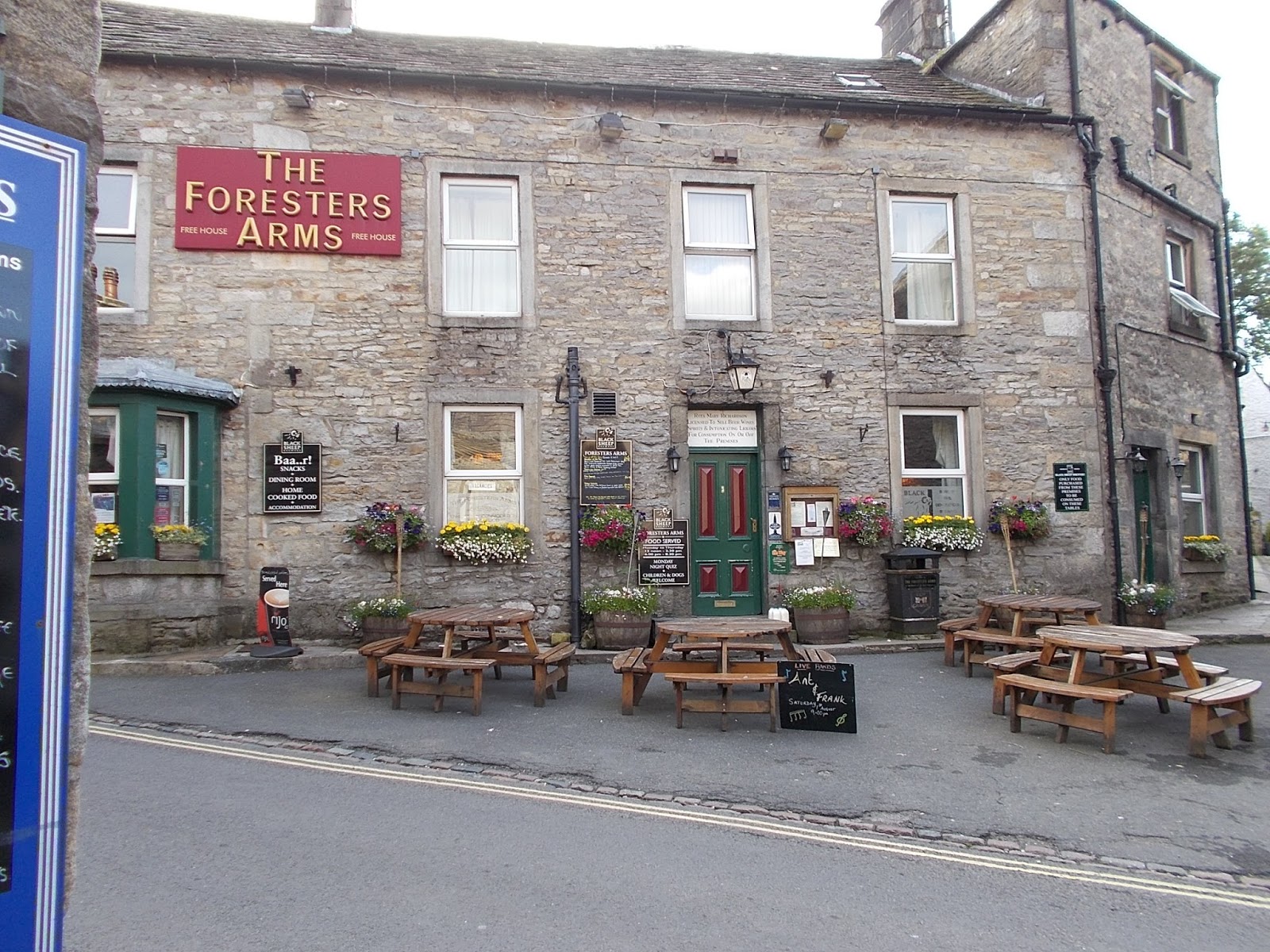
But what temptations, with a chocolate shop, a bookstore next door, and the pub only 23 paces away! Here's the pub, The Forrester's Arms:


The pub had a quiz night on Mondays, but we were too tired to go, having spent most days taking walks.


Who knew dogs and children were big trivia fans?

The butcher shop was right up the street. One day, Kevin saw another butcher's van in town with a sign on the back: "Sausages are not left in this van overnight."  We didn't know if it was a real attempt to deter thieves or just good old British humor.


The hardware store on the same block seemed to have everything--even needles and thread--and the people there were very friendly.


I'm sorry I didn't get a photo of The Corner Cafe, our favorite coffee shop, particularly favored because it had wifi, which sadly our beautiful little cottage lacked.  (That was about all it lacked though.)

We chose Grassington because it is a walking center with many walks leaving right from our door, or just a short bus ride away. We are also doing without a car on this leg of our trip, to save money in an expensive country, so having the good transport links helped tremendously. We really didn't do much while we were there but walk, relax, and eat. 


Tuesday, August 4, 2015

Durham: A Cathedral and a Castle


Inside the castle walls. (I'm so tired of that Anorak, but it's been cool everywhere!)

Durham holds a unique place in English history. Because the English king could not effectively govern that far north, in 1075, he made the Bishop of Durham a Prince Bishop, with powers to levy taxes and raise armies—effectively making the Bishop of Durham the ruler of the region as long as he swore loyalty to the crown. That status lasted for centuries.

Durham Cathedral makes a stately presence over the green it shares with the castle.

Durham Cathedral is considered the finest Norman cathedral in Europe.  It dates from 1093, and it has been extended and remodeled over the centuries. (We saw a line in the floor—very near the door—that marked the small area where women were permitted to enter in medieval days. It would have been unthinkable to let them get any closer to the altar!) 

Additions are still being made to the cathedral.  I wouldn't expect to like seeing a new window in such an old, historic structure. But one of my favorite stained-glass windows at Durham was the Transfiguration Window, which was installed in 2011. It all blends together well. 

What impressed me more than the shrine of St. Cuthbert was the tomb of the "Venerable Bede" (St. Bede), which is also in Durham Cathedral. He lived sometime between 673-735. I remember studying him in my European medieval history course, so it was interesting to find his resting place. I found him fascinating not for his religious associations, but because he was known as a great scholar who wrote and translated about 40 books, including some on nature, astronomy, and poetry. He is celebrated as the first English historian.